
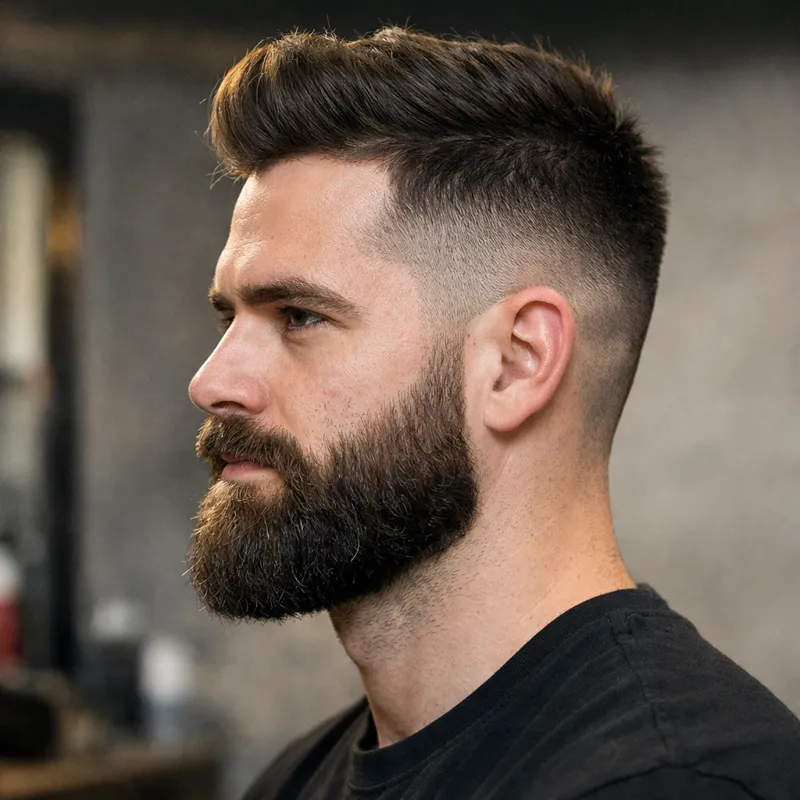
Short beards are having a real moment. They look sharp at the office, relaxed on the weekend and work with almost every hairstyle. If you want a beard that’s clean, masculine and easy to maintain, a short style is your best friend.
In this guide you’ll see which short beard styles actually suit different face shapes, how to ask your barber for the look you want, and how to maintain everything at home without overcomplicating your routine.
Why Short Beard Styles Work So Well
Short beards sit in the sweet spot between a heavy stubble and a full lumberjack beard. That balance gives you structure around the jaw without hiding your features or demanding a lot of daily work.
Main benefits of a short beard
- Versatile: Works with buzz cuts, fades, classic side parts and long hair.
- Professional: Easier to keep office‑friendly than a long, wild beard.
- Low maintenance: A few minutes every 2–3 days is usually enough.
- Face‑shaping: Helps define the jawline and balance the proportions of your face.
- Beginner‑friendly: Easier to grow and shape if you’re new to beards.
Think of a short beard as part of your overall haircut, not something separate. The cleaner the connection between your beard and your haircut, the more intentional and stylish it looks.
Short Beard Basics: Growth, Density and Neckline
Before you pick a style, you need to know what you’re working with. Your beard’s growth pattern and density will decide which short style looks best on you.
How long to grow for a short beard
- Light stubble: 1–3 days of growth.
- Designer stubble: 4–7 days of growth.
- Short boxed beard: around 2–4 weeks of growth.
Most structured short beards start to take shape after two good weeks of growth, when you can see how your cheeks, jaw and chin fill in.
Checking your beard density
Stand in good light and look for these signs:
- Even coverage: You can pull off almost any short style.
- Patchy cheeks, strong chin and moustache: Go for styles that focus length around the chin.
- Patchy overall: Designer stubble usually looks better than trying to force a full beard.
Neckline: the non‑negotiable detail
A messy neckline can ruin even the best short beard. A clean neckline, on the other hand, instantly makes you look groomed and intentional.
- Look straight ahead in the mirror.
- Find your Adam’s apple. Place two fingers above it.
- Mark that spot: that’s where your neckline should normally sit.
- Draw a gentle curve from just behind one ear, through that point, to just behind the other ear.
- Shave everything below this line with a razor or foil shaver.
According to master barber Jake Thompson, whose experience with fades and beard trims is grounded in day‑to‑day work behind the chair, a sharp neckline is the quickest way to make any short beard look “finished” without adding length or complexity.
The Most Popular Short Beard Styles
There are dozens of variations, but most short beard looks fall into a few clear families. Once you understand these, you can adjust length, sharpness and shape to suit your face and lifestyle.
1. Light Stubble
Light stubble is the “I didn’t shave for a couple of days” look – simple, relaxed and flattering on most faces. It adds a bit of shadow and definition without looking like a full beard.
Who it suits
- Men who need a conservative look for work.
- Anyone whose beard grows unevenly past a few days.
- Guys with baby‑face features who want a little more edge.
How to get the look
- Let your beard grow for 2–4 days.
- Set your trimmer to 0.5–1 mm.
- Run the trimmer evenly over your entire beard area, including the moustache.
- Clean up the neckline using the guideline above.
- Shave any hair above the main beard line on the cheeks for a tidy finish.
Maintenance
Trim every other day to hold the same length. This style takes under five minutes to maintain once you get into the habit.
2. Designer Stubble
Designer stubble is a thicker, more intentional version of basic stubble. The edges are sharper, the length is slightly longer, and it clearly looks like a choice, not an accident.
Who it suits
- Men who like a casual‑smart look.
- Faces that benefit from more jaw definition.
- Guys with decent but not perfect coverage on the cheeks.
How to get the look
- Grow your beard for 5–10 days.
- Set your trimmer to 1.5–3 mm.
- Trim all over in the direction of growth for an even result.
- Use the trimmer without a guard to sharpen cheek lines and tidy under the lower lip.
- Shave the neck below the neckline for contrast.
Maintenance
Trim every 2–3 days. Use a small amount of beard oil to keep the skin comfortable and prevent itch as the hair gets slightly longer.
3. Short Boxed Beard
The short boxed beard is the classic “boardroom‑ready” beard: strong enough to define your jaw and chin, short enough to stay sharp.
Who it suits
- Most face shapes, especially round and oval faces.
- Men with good coverage on cheeks, jaw and chin.
- Anyone who wants a professional beard that still feels masculine.
How to get the look
- Grow your beard for 2–4 weeks without trimming length.
- Once you have full coverage, set your trimmer to 4–7 mm depending on how thick your hair is.
- Trim the sides (cheeks and sideburns) slightly shorter than the chin to create structure.
- Define a clean cheek line with either a razor or the bare trimmer.
- Keep the neckline slightly higher and very sharp.
Maintenance
Shape every week and line up the cheeks and neck every 3–4 days. Comb the beard before trimming to avoid uneven patches.
4. Short Beard with Fade
If you already wear a fade or taper on the sides, blending your beard into the haircut can look incredibly clean. This style uses gradually longer clipper guards from the temple down into the beard.
Who it suits
- Men who like modern, barbershop‑style haircuts.
- Guys with thicker beards that can handle a lot of shaping.
- Round or square faces that benefit from more vertical emphasis.
How to get the look
You’ll get the best result with a barber, especially the first time. Here’s how to explain it:
- Show a photo where the fade runs from the haircut into the beard.
- Ask for the temple area to be the shortest point and the chin to be the longest.
- Mention the exact guard length you prefer on the beard (for example 3–5 mm).
At home, you can maintain the fade by cleaning the neckline and lightly trimming bulk from the sides, leaving the detailed fading for your regular barber visit.
5. Goatee and Short Variations
A goatee focuses hair around the mouth and chin, leaving the cheeks clean‑shaven. Modern short goatees are neater and slightly longer at the chin to add length to the face.
Who it suits
- Guys with patchy cheeks but strong chin and moustache growth.
- Round faces that need more vertical length.
- Men who like a lower‑maintenance option that still feels styled.
How to get the look
- Let your beard grow for 1–2 weeks.
- Shave both cheeks clean, stopping just next to the corners of your mouth.
- Leave hair on the chin and moustache connected, or keep a small gap under the lower lip if you prefer.
- Trim the goatee to 5–10 mm depending on your taste.
- Shape the outline into a soft rounded or subtle point at the chin.
Maintenance
Shave cheeks and neck every 1–2 days to keep the contrast strong. Trim the goatee every week to avoid it turning into a full beard.
6. Short Beard with Moustache Focus
If your moustache is naturally strong, you can keep the beard shorter and let the moustache be the star. This works well with classic haircuts and side parts.
How to get the look
- Trim the beard to 2–4 mm all over.
- Leave the moustache slightly longer, around 4–6 mm or more, and trim only the bottom line above the lip.
- Keep cheek lines soft rather than razor‑sharp to avoid competing with the moustache.
If you’re unsure which short beard style to start with, choose designer stubble. Once that feels natural, you can slowly increase length on the chin or switch to a boxed beard.
Matching Short Beard Styles to Your Face Shape
Short beards are great for balancing your features. The key is knowing what you want to emphasise or minimise.
Round face
Goal: add length and create the illusion of a stronger jawline.
- Keep the cheeks shorter and the chin slightly longer.
- A short boxed beard or goatee variation works well.
- Avoid heavy side growth that widens the face.
Square face
Goal: soften very strong angles slightly.
- Keep length fairly even but round off the corners of the jaw with your trimmer.
- Short boxed beards with softer lines are ideal.
- Light stubble also works if you want a minimal look.
Oval face
Goal: maintain balance and highlight your features.
- You can wear almost any short beard style.
- Focus on clean lines and a neat neckline more than changing the shape.
Long face
Goal: reduce the impression of length.
- Keep the chin slightly shorter and allow more fullness on the sides.
- Designer stubble or a short, fuller beard along the jaw works well.
- Avoid pointy goatees that pull the eye downward.
Tools and Products You Actually Need
You don’t need a drawer full of gadgets to wear a great short beard. With a few reliable basics you can handle almost everything at home.
Essential tools
- Beard trimmer with guards: Look for 0.5–10 mm settings and a solid battery life.
- Detail trimmer or precision head: Helpful for shaping cheek lines and the area under the lip.
- Razor or foil shaver: For a clean neckline and cheeks.
- Beard comb: To lift hairs before trimming for an even cut.
- Scissors (optional): For fine‑tuning the moustache and stray hairs.
Basic care products
- Gentle face wash or beard wash: Keeps the skin clean without stripping natural oils.
- Beard oil: Reduces itch and softens hair, even on short beards.
- Light beard balm or cream: Adds very subtle control if your hair is wiry.
Use beard oil after a shower on slightly damp skin. 2–4 drops are usually enough for most short beard styles.
How to Maintain Your Short Beard Day to Day
Once your beard is shaped, the secret is routine. A simple, consistent system beats a complicated one you never follow.
Daily routine (2–3 minutes)
- Rinse your face and beard with lukewarm water; use a gentle wash if needed.
- Pat dry with a towel; don’t rub aggressively.
- Apply a few drops of beard oil and massage into skin and hair.
- Comb the beard in the direction of growth.
Every 2–3 days
- Trim the beard with your chosen guard length.
- Clean up the neckline and top cheek line.
- Check the area under the lower lip for stray long hairs and trim.
Weekly
- Take an extra 5–10 minutes to check the overall symmetry in good light.
- Adjust the length slightly if the beard is getting too heavy for the style.
How to Talk to Your Barber About Short Beard Styles
Bringing the right photo is helpful, but the conversation matters just as much. Barbers think in terms of length, lines and balance, so speak their language in simple terms.
Key points to mention
- Overall length: Short stubble, medium stubble, or short beard.
- Shape goal: Sharper jaw, softer lines, more emphasis on the chin, or very even all over.
- Neckline position: Higher (sharper) or slightly lower (more natural).
- Maintenance level: How often you’re realistically willing to trim.
Sample phrases you can use
- “I’d like a short boxed beard, about 5 mm, with a clean neckline.”
- “Can you fade my beard into my haircut so it blends from the temple?”
- “Keep the cheeks a bit shorter and leave more weight on the chin.”
- “I need something that still looks neat if I don’t trim it for four days.”
Don’t be afraid to ask your barber which guard length they used. That information makes it much easier to maintain the same look at home.
Fixing Common Short Beard Problems
Even with a simple style, you might run into a few issues. Most are easy to fix with small adjustments.
Patchy areas
- Keep the beard slightly shorter so the contrast between dense and sparse areas is lower.
- Consider a goatee or moustache‑focused style if cheeks refuse to fill in.
- Give it a full month before judging your natural coverage.
Itch and irritation
- Use beard oil daily, especially during the first few weeks of growth.
- Avoid very hot water on your face; it dries out the skin.
- Change razor blades often if you shave your neck or cheeks.
Uneven sides
- Comb the beard out before trimming; don’t trim it when it’s still compressed from sleep or a mask.
- Always trim in good, even light, checking both sides straight on.
- If you over‑trim one side, match the shorter side rather than chasing the length.
FAQ: Short Beard Styles
How long does it take to grow a good short beard?
Most men need around 2–4 weeks to grow a solid short beard. Stubble looks intentional after about 5–7 days, while a short boxed beard usually needs at least two weeks of uninterrupted growth before shaping.
Can I pull off a short beard if my cheeks are patchy?
Yes. If your cheeks are patchy, keep the overall length shorter and focus more bulk on the chin and moustache. Goatee variations, short stubble, or a beard with slightly faded cheeks tend to look better than trying to force full coverage.
How often should I trim a short beard?
For light or designer stubble, trim every 1–3 days to keep the length consistent. For short boxed beards, a weekly shape‑up plus a quick neckline cleanup every few days is usually enough to stay sharp.
Do I really need beard oil for a short beard?
Beard oil is still useful on short beards. It softens the hair, reduces itch and keeps the skin hydrated. Use a small amount – a few drops – to avoid looking greasy while still getting the benefits.
Where should my short beard neckline sit?
A good general rule is two fingers above your Adam’s apple, then a smooth curve towards the back of each jaw. Shave everything below that line. If you have a very short neck, you can set the line slightly lower to avoid shortening it visually.