
Local Services • Beard Trimming
Beard Trimming Shears: The Clean, Controlled Way to Trim With Scissors
If your beard looks “almost great” but never truly sharp, you usually don’t need a shorter beard — you need a cleaner silhouette. That’s exactly what beard trimming shears are for. This guide shows you how to get a barber-level finish with scissors for beard trimming, when to switch to clippers, and how to keep the result looking intentional between trims.

Beard trimming shears are about precision: cleaner lines, fewer mistakes, and a more natural finish than aggressive trimming.
What Are Beard Trimming Shears (and Why They Change Everything)
Beard trimming shears are grooming scissors made to cut coarse facial hair cleanly without tugging, crushing, or leaving frayed ends. They’re not about taking your beard dramatically shorter. They’re about making your beard look deliberate.
Most “messy beards” aren’t actually too long — they’re uneven. Hair grows at different speeds across the cheeks, jaw, chin, and mustache. A clipper pass can make everything the same length, but it can also remove the natural density that makes a beard look full. Scissors give you a different superpower: you can remove only what doesn’t belong.
What scissors do best
- Flyaway control: snip hairs that stick out and ruin the outline.
- Natural finish: keep density while refining the shape.
- Mustache detail: precision around the lip without buzzing too short.
- Low-risk trimming: tiny cuts, gradual change, fewer “I messed up” moments.
What clippers do best
- Uniform length: consistent results fast on short-to-medium beards.
- Bulk removal: quickest way to reduce length significantly.
- Edges: neckline and borders (when you want crisp definition).
- Fades/blends: tapering into sideburns (best done by a pro if you want it perfect).
Key takeaway: The highest-confidence approach for most men is clippers for length + beard trimming shears for finishing. If you’re trimming a medium or longer beard, scissors often become the “main tool” because they keep fullness.
Scissors for Beard Trimming: The Buying Checklist (No Fluff)
You don’t need a complicated kit. You need one pair of scissors that cuts cleanly and feels stable in your hand. If your scissors snag hair or feel loose, your trim becomes slower, riskier, and more frustrating.
| Feature | Why it matters | What to choose | What to avoid |
|---|---|---|---|
| Sharpness | Clean cuts reduce frayed ends and prevent tugging. | Shears that cut smoothly through coarse hair. | Dull blades that “pull” before they cut. |
| Control | Beard trimming is facial work — precision beats speed. | Compact grooming scissors that feel balanced. | Oversized household or tailor scissors. |
| Tip shape | Safer around mustache corners and tight areas. | Fine tip with stable handling (careful trimming). | Extremely sharp tips if you rush or tremble. |
| Tension/pivot | Loose scissors = uneven cuts and more errors. | Stable pivot, smooth open/close action. | Wobble, squeak, or uneven resistance. |
| Comfort | Comfort = slower, steadier, better symmetry. | Finger holes that fit without forcing grip. | Painful pinch points that make you hurry. |
A minimal, high-impact kit
- Beard trimming shears (your precision tool)
- Comb (controls sections and exposes uneven hairs)
- Bright light + mirror (symmetry depends on visibility)
- Optional: trimmer for neckline and borders
Pro move: If you only upgrade one thing, upgrade your scissors. Most “bad trims” are really “bad control.”

A comb exposes uneven hairs so you trim intentionally.

After-trim conditioning makes the beard look “finished,” not dry.
Scissors vs Clippers: Which One Should You Use?
This is where most men waste time: trimming with the wrong tool for the job. If you match the tool to your beard length and goal, your results jump immediately.
Fast rule: If you’re keeping a medium or longer beard, start with trimming beard with scissors to protect fullness. If you’re maintaining a short, uniform beard, trim beard with hair clippers first, then finish with scissors.
| Your situation | Best tool | Why | What to watch out for |
|---|---|---|---|
| Stubble / very short beard | Clippers/trimmer | Uniform length is the goal; scissors are slow and higher risk close to skin. | Going too short too fast. Start longer than you think. |
| Short-to-medium beard (you want it tidy) | Clippers + scissors | Clippers set length quickly; shears refine flyaways and mustache detail. | Skipping the finishing pass makes the outline look fuzzy. |
| Medium-to-long beard (keep fullness) | Beard trimming shears | You can remove only what sticks out without thinning the beard. | Trying to “equalize” everything. Trim what breaks the silhouette, not everything. |
| Big length change | Clippers first | Speed and consistency. Then refine with scissors. | Not blending transitions (cheek/jaw/chin). Consider a pro for the first reshape. |
| Sharper neckline & cheek line | Trimmer + shears | Trimmer sets a clean boundary; shears soften the finish so it looks natural. | Carving too low or too high. A harsh line can make the beard look smaller. |
The “barber finish” secret
A beard can be the right length and still look unkempt if the outline has tiny inconsistencies. Barbers don’t just set length — they refine the silhouette. That silhouette is what your eyes read first.
- Length gives the beard its weight.
- Lines give it intent.
- Texture (flyaways) decides if it looks polished.
Beard trimming shears are the tool that targets texture without sacrificing weight.
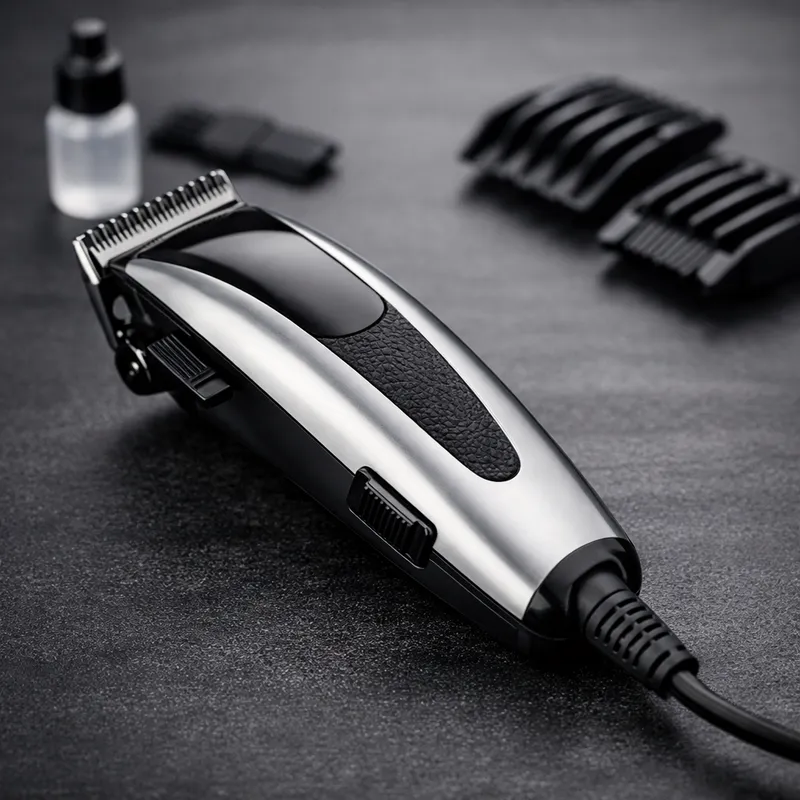
Clippers are powerful — which is why they’re also easier to overdo. Use them to set length, then refine.
How to Trim a Beard With Scissors (The Controlled, No-Regrets Method)
This method is designed for real life: uneven growth, imperfect mirrors, and the common fear of taking off too much. The goal is not to chase perfection in one session. The goal is to build a beard that looks consistently sharp — with small, repeatable trims.
Safety note: Trim slowly. Use good lighting. If you feel rushed, stop. The most common scissor accidents happen when you “just fix one more spot.”
The 3-Pass System (what barbers do differently)
Most DIY trims fail because men try to achieve the final shape in one pass. Instead, use three passes: rough → refine → finish. Each pass is small. Each pass improves the silhouette.
-
Pass 1 — Dry, detangle, and reveal the shape
Rinse if needed, then dry your beard fully. Comb down and out to expose hairs that stick past the outline. Dry hair shows the real length — wet hair lies and makes you cut too much.
-
Pass 1 — Flyaway cleanup (lowest risk, biggest payoff)
Comb the beard into its natural fall. Snip only the hairs that clearly extend beyond the silhouette. Think “dusting” the edges, not “removing length.”
-
Pass 2 — Reduce bulk (only if you truly want shorter)
Work in small sections. Comb a section outward, then take tiny snips across the ends. Keep both sides symmetrical by alternating: left section → right section → re-check.
-
Pass 2 — Define transitions (cheek → jaw → chin)
Most beards look uneven because the chin area holds more length and the cheeks are lighter. Don’t force equality. Refine transitions so the beard looks intentional from the side view.
-
Pass 3 — Mustache control (the detail zone)
Comb the mustache down over the lip, then remove only what enters the mouth or touches the lip line. If you want a fuller mustache, trim less — just clean the center and corners.
-
Pass 3 — Final silhouette check (3 angles)
Check front symmetry, side silhouette, and the 45-degree angle (where unevenness is easiest to spot). If something looks off, fix the smallest piece first.
Pro tip: When trimming beard with scissors, your goal is a clean outline. If you keep re-cutting the same area, you’ll thin the beard without improving the shape. Make one small change, then reassess.
How to Trim a Beard With Clippers (Fast, Even, and Harder to Mess Up)
Clippers are unbeatable for setting an even length quickly — especially on short-to-medium beards. But because they remove hair fast, the best results come from a conservative, step-down approach. If you’re going to trim beard with hair clippers, this section keeps it controlled.
The “Start Long, Step Down” approach
- Start longer than you think you need. You can always go shorter.
- Go with the grain first to avoid taking off too much.
- Refine with a shorter guard only where the beard truly needs it.
- Finish with scissors to remove flyaways and soften the outline.
-
Set the main length (guard on, go slow)
Pick a guard length and do a full pass with the grain. This sets a baseline. If it still looks bulky, step down one guard size and repeat.
-
Blend the top of the beard (optional, looks professional)
Slightly shorter near the sideburn transition can make the beard look sharper without looking “carved.” If you’re unsure, skip this and keep it uniform.
-
Edges and neckline (use a trimmer carefully)
Clean up the neckline and borders. Don’t set the neckline too high — it makes the beard look smaller. Keep cheek lines believable for your growth pattern.
-
Finish with beard trimming shears
Even after clipping, stray hairs will stick out. Use shears to refine the silhouette, especially the mustache, corners, and under-chin outline.
Neckline & Cheek Line Rules (The “Looks Clean” Blueprint)
A beard can be the perfect length and still look off if the lines are wrong. Most men don’t need a sharper beard — they need a better line strategy.
Neckline rules (simple and reliable)
- Don’t trim the neckline too high. High necklines shrink the beard and can widen the neck.
- A soft U-shape beats a straight line. Straight lines look unnatural from the side.
- Blend, don’t stamp. After defining the line, soften the transition with a light pass.
High-confidence approach: If you’re unsure, keep the neckline slightly lower and cleaner, rather than higher and aggressive.
Cheek line rules (clean, not carved)
- Follow your natural growth. A line that fights your growth pattern looks artificial.
- Patchy cheeks? Keep the line softer to avoid calling attention to gaps.
- Dense cheeks? You can go cleaner — but avoid dropping the line too low.
The best cheek lines look believable up close and sharp from a distance.
Beard Trim Planner: Scissors vs Clippers (Personalized Plan in 20 Seconds)
This quick planner gives you a recommended tool strategy, a trim order, and a maintenance schedule. It’s built around the real decision that matters: your beard length, your goal, and your risk tolerance.
This tool is informational and designed to reduce trimming mistakes. If you want a guaranteed pro finish, use the CTA below and get the first shape set professionally.
Your plan will appear here
Tip: A great beard trim is usually a sequence, not a single action: set length → refine silhouette → detail mustache → check lines.
Barber Script Builder: Get Exactly the Beard Trim You Mean
“Beard trim” can mean ten different things. When you’re vague, you get a generic result. Use this script builder to generate a clear, barber-friendly request — then copy it in one click.
The goal is clarity, not complexity. A good barber loves specific, simple instructions.
Your barber script
Maintenance Plan: The Schedule That Keeps Your Beard Looking “Done”
A great beard isn’t built with one perfect trim. It’s built with a simple system that prevents the beard from drifting into “sloppy territory.” The biggest difference between a beard that always looks good and one that’s unpredictable is not genetics — it’s maintenance frequency.
Daily (1–2 minutes)
- Comb/brush to reset the silhouette and spot flyaways early.
- Keep the mustache from entering the mouth (tiny trims beat big trims).
- Add a small amount of beard oil if your beard looks dry or frizzy.
Weekly (8–12 minutes)
- Scissors pass: trim flyaways and uneven ends.
- Quick neckline check: clean edges without raising the line.
- Re-check symmetry from the front and side.
Every 2–4 weeks (reset)
- Short beard: clippers set length, scissors refine.
- Medium/long beard: scissors shape, clippers only if reducing length.
- Line upgrade: if you want a bigger change, get the first “line set” professionally.
Why a pro trim converts into easier DIY: Once a barber sets a balanced outline, your home trims become maintenance instead of “guessing.” That’s the difference between a beard that always looks sharp and one that’s a coin flip.
Common Mistakes (and How to Avoid Them)
Most trimming disasters come from the same patterns. Fix the pattern, and the result improves immediately.
High-impact mistakes
- Cutting wet: wet hair lies. Dry trimming shows true length.
- One big pass: use the 3-pass system to protect your beard.
- Over-carving lines: crisp is good; carved is obvious.
- Chasing symmetry too aggressively: micro-adjustments beat panic trimming.
- Dull scissors: tugging leads to slips and uneven cutting.
Simple fixes that work
- Trim in tiny increments: a little, then reassess.
- Alternate sides: left → right → check. It keeps balance.
- Use a comb: if you don’t comb between passes, you’re trimming blind.
- Check the side silhouette: it reveals bulk and uneven transitions.
- Finish with scissors even after clipping: it’s the difference between “short” and “sharp.”
Want the Sharpest Result? Get the First Shape Set by a Pro
If you’ve been trimming at home and the beard still looks “almost right,” the missing piece is usually a clean, balanced outline. A professional beard trim can set the foundation — then you maintain it with quick scissor cleanups.
No forms here — just clear next steps. Use the Barber Script Builder above and bring it to your appointment.

A pro trim sets the “framework.” After that, beard trimming shears make maintenance easy.
Frequently Asked Questions About Beard Trimming Shears
These answers are written for real trimming decisions: what tool to use, how often to trim, and how to avoid the most common mistakes when trimming beard with scissors or clippers.
Are beard trimming shears different from regular scissors?
Should I trim my beard wet or dry with scissors?
Is trimming beard with scissors better than trimming beard with clippers?
How do I avoid cutting too much with beard scissors?
How often should I use scissors for beard trimming?
What’s the best way to trim the mustache without ruining it?
When should I stop DIY and get a professional beard trim?
Why does my beard still look messy after trimming?
Want to keep reading? Go back to the Scissors vs Clippers matrix or use the Beard Trim Planner to generate a personalized routine.