
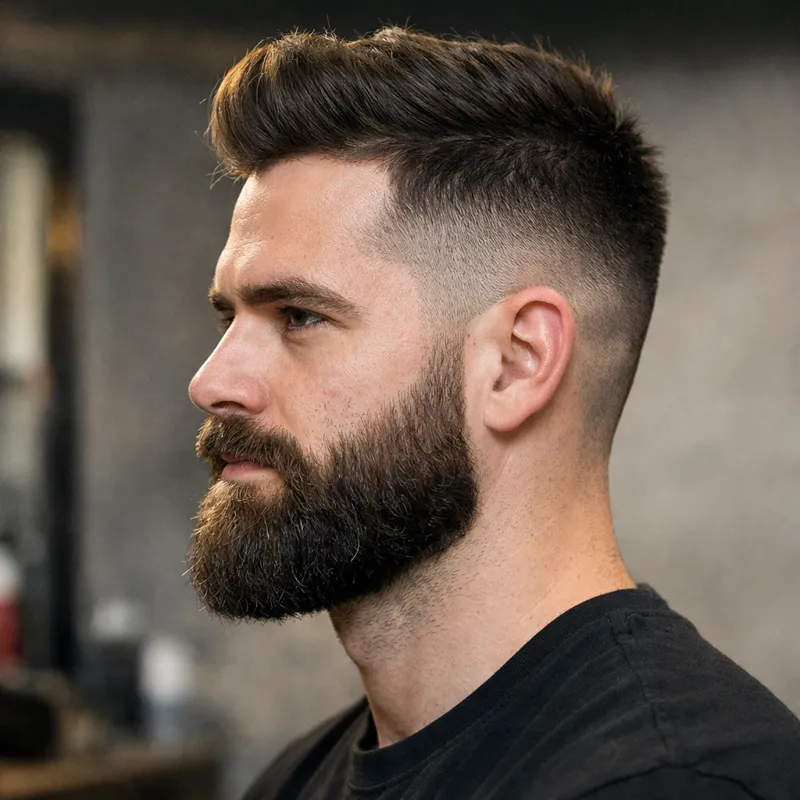
You don’t need a perfect jawline to wear a great beard. You need the right beard idea for your face, the right tools and a simple plan to keep it sharp. That’s what we’ll break down here.
In this guide, you’ll see which beard styles work best for different face shapes, how to grow and shape them step by step, and the products and routines that actually matter. Think of it as sitting in the barber chair while someone walks you through the why and the how.
How to Choose the Best Beard Style for Your Face
Before you copy any beard from social media, you need to understand what you’re working with: face shape, hair density and growth patterns. The goal is simple: use the beard to balance your features and sharpen your jawline.
Step 1: Identify Your Face Shape
Stand in front of a mirror in good light, pull your hair back and look at your outline.
- Oval: Forehead slightly wider than the chin, rounded jaw, overall balanced.
- Square: Strong, wide jaw with angular corners, forehead similar width to jaw.
- Round: Cheeks are fuller, width and length of the face are similar.
- Rectangle / Oblong: Face noticeably longer than it is wide.
- Triangle: Jaw wider than forehead, chin more prominent.
Step 2: Match Face Shape to Beard Ideas
Here are beard ideas that usually work well with each face shape, plus why they work:
- Oval face: Almost anything works. Try a full short beard, faded beard, stubble or a boxed beard. Your job is to keep everything neat and proportional.
- Square face: Soften the corners with a beard that has a bit more length at the chin and slightly shorter sides. A rounded full beard or short boxed beard with a subtle point works well.
- Round face: Add vertical length. Go for a goatee with short cheeks, a Van Dyke, or a full beard that is trimmed shorter at the sides and longer at the chin.
- Rectangle / oblong face: Avoid extra length at the bottom. A fuller cheek beard and a shorter chin area create balance. Short boxed beards and heavy stubble are ideal.
- Triangle face: Build some width at the cheeks and keep the chin from looking too long or pointy. A full beard with even length or a classic beard with softer edges works well.
Quick rule: If your face is wide, use the beard to add length. If your face is long, use the beard to add width. If your jaw is very strong, soften the lines slightly; if it’s weak, sharpen it with a defined outline.
Essential Tools and Products to Get Any Beard Look
Good tools make beard styling faster and more precise. You don’t need a full barbershop setup, but you do need a few basics.
Core Tools
- Beard trimmer with guards: For setting overall length on cheeks, jaw and neck.
- Detail trimmer or precision attachment: For clean lines around the moustache, lips and edges.
- Razor (cartridge or safety): For shaving cheeks and neck below the beard line.
- Grooming scissors: For snipping stray hairs, moustache length and small corrections.
- Beard comb and/or brush: To detangle, train the direction of growth and blend.
Beard Care Products
- Beard wash or gentle cleanser: Keeps the skin and hair clean without drying them out.
- Beard oil: Hydrates, reduces itch and gives a healthy, light sheen.
- Beard balm or cream: Adds light hold and helps shape, especially on medium to longer beards.
- Exfoliating scrub (weekly): Helps prevent ingrown hairs and flakes.
Classic Beard Ideas for Men and How to Get Them
Now let’s look at specific beard styles and how you can recreate them at home, step by step.
1. Designer Stubble (The 3–5 Day Beard)
Designer stubble is the easiest, most universal beard style. It works for almost every face shape and pairs especially well with short haircuts and fades.
How to get the look
- Let your beard grow for 3–5 days without shaving.
- Set your trimmer guard between 1–3 mm, depending on how heavy you want the stubble.
- Trim evenly over your cheeks, jaw, moustache and chin.
- Clean the neck: shave any hair below the Adam’s apple and fade upwards slightly with a higher guard.
- Define the cheek line: either follow your natural line or clean it up with a razor in a gentle curve from sideburn to moustache.
Maintenance tips
- Trim every 2–3 days to keep the same length.
- Use a small amount of beard oil if the skin feels dry or itchy.
- Pair with a clean haircut like a crew cut, fade or textured crop for a sharp contrast.
2. Short Boxed Beard
The short boxed beard is a defined, professional beard that outlines the jaw without looking wild. It’s ideal if you want something more than stubble but still office‑friendly.
How to get the look
- Grow your beard for 2–4 weeks until the cheeks, chin and moustache are filled in.
- Decide your length: usually between 5–12 mm. Start longer; you can always go shorter.
- Use a trimmer with the chosen guard and go over the entire beard for an even base.
- Define the cheek lines: create a clean, slightly curved line from sideburn to moustache on each side.
- Shape the neckline: place two fingers above your Adam’s apple; this is where your beard should end. Trim everything below.
- Taper the neck: use a shorter guard just under the jaw to blend into the shaved neck.
- Trim the moustache so it sits just above the lip line without stray hairs.
Who it suits
- Oval and square faces: Enhances natural structure.
- Round faces: Works if you keep the sides slightly shorter and the chin slightly longer.
- Men who need a neat, professional look but still want a noticeable beard.
3. Full Beard (Short to Medium Length)
A full beard is a statement. When it’s shaped properly, it strengthens the jawline and can slim the face. When it’s neglected, it can swallow your features, so structure is key.
How to get the look
- Allow at least 4–8 weeks of growth. Resist the urge to heavily shape it too early.
- After the first 2 weeks, start maintaining a clean neckline and cheek line to keep things intentional.
- Once you reach your target length, choose a guard slightly shorter than the longest hairs and even out the whole beard.
- Use scissors to remove bulky sections and split ends, especially at the chin and under the jaw.
- Decide on the shape: more rounded for square faces, slightly pointed for round faces, flatter bottom for oblong faces.
- Comb the beard daily and apply beard oil to keep it soft and controlled.
Maintenance tips
- Trim every 1–2 weeks to maintain shape.
- Wash 2–3 times per week with beard wash; rinse with water on other days.
- Use a balm if you need light hold and extra conditioning.
4. Goatee Variations
Goatees focus on the chin and moustache, making them perfect for adding length to a round face or highlighting the centre of your face.
Popular goatee options
- Classic goatee: Hair only on the chin, no moustache.
- Full goatee: Chin and moustache connected in a circle or oval.
- Van Dyke: Separate moustache and pointed chin beard.
How to get the look
- Grow a short beard for 1–2 weeks to have enough hair to shape.
- Decide your outline: usually slightly narrower than the mouth for a more refined look.
- Shave the cheeks completely with a razor, keeping only the hair around the mouth and chin.
- Use a detail trimmer to clean the edges and keep the lines symmetrical.
- Choose a length between 3–10 mm, depending on how bold you want it.
If your cheeks are patchy but your chin and moustache grow well, a goatee lets you work with your strengths instead of fighting your genetics.
5. Faded Beard with Short Hair
A faded beard blends smoothly from the sideburns into the beard, matching the fade on your haircut. It looks modern and clean, especially with short or textured styles on top.
How to get the look
- Ask your barber for a haircut with a fade or taper on the sides. This creates the base to match your beard.
- At home, decide the main beard length (for example, 6 mm on the cheeks and jaw).
- Use a shorter guard (for example, 3–4 mm) at the sideburns and blend down into the full beard length.
- Work in vertical sections in front of the ear, moving down and forward.
- Check both sides in the mirror for symmetry and adjust slowly—take off less rather than more.
- Define cheek and neck lines as you would for a short boxed beard.
Who it suits
- Men who already wear fades or modern short hairstyles.
- Anyone who wants a sharp, current look that still works in most workplaces.
How to Grow a Better Beard: Routine and Habits
If you’re not naturally full‑bearded, you can still improve what you have. Focus on health, patience and smart grooming instead of chasing miracle solutions.
Daily Beard Care Routine
- Morning rinse: Splash your beard with lukewarm water to wake it up and remove any product from the night.
- Beard oil: Apply a few drops to your palms, rub them together and work the oil into the skin under the beard, then through the hair.
- Comb or brush: Comb downwards and then into your desired shape. This trains the hairs to lie in the same direction.
- Light styling: If needed, use a small amount of balm to control flyaways, especially on the cheeks.
Weekly and Monthly Habits
- 2–3 times per week: Wash with a beard wash or gentle shampoo.
- Once per week: Exfoliate the skin under the beard with a facial scrub to prevent ingrown hairs.
- Every 1–2 weeks: Trim to maintain your chosen shape and length.
- Every 4–6 weeks: Visit a barber for a professional shape‑up if you want to keep everything perfectly balanced.
Lifestyle Factors That Impact Beard Growth
You can’t change your genetics, but you can make sure you’re not holding your beard back.
- Sleep: Aim for consistent, quality sleep. Your body grows and repairs hair while you rest.
- Nutrition: A balanced diet with enough protein, healthy fats and vitamins supports hair growth.
- Stress: High stress levels can negatively affect hair growth. Exercise and relaxation help.
- Patience: Many beards look patchy in the first month. Give it at least 8–12 weeks before judging the result.
How to Shape Beard Lines Like a Barber
Sharp lines are what turn a casual beard into a deliberate style. Once you understand cheek lines and necklines, you can maintain the shape at home.
Cheek Lines
Your cheek line is the border between the beard and the smoother part of your cheek.
- Natural line: Follow your natural growth, only cleaning up stray hairs above the main beard mass. This looks softer and more relaxed.
- Defined line: Use a razor or detail trimmer to create a clean curve or straight line from the sideburn to the corner of the mouth.
For round faces, raising the cheek line slightly can make the face appear slimmer. For long faces, a slightly lower cheek line can add more beard mass and balance.
Necklines
The neckline is where most men go wrong—too high makes the beard look like a chin strap, too low looks messy.
- Look straight ahead and find your Adam’s apple.
- Place two fingers above it; draw an imaginary horizontal line from that point to each side of your neck.
- This is your ideal neckline. Everything below gets trimmed or shaved.
- From the jaw angle to this line, create a gentle curve on each side.
- Use a shorter guard under the jaw to fade into the clean‑shaven neck for a softer transition.
Moustache Detailing
A messy moustache can ruin a great beard. Keep it clean with these steps:
- Comb the hairs down over your lip.
- Use grooming scissors to cut along the lip line, following the natural curve.
- If you prefer a thicker moustache, only trim the very tips that touch the lip.
- For a minimal look, trim with a guard slightly shorter than the rest of your beard.
Matching Your Beard to Your Hairstyle
Your beard and hair should look like they belong to the same person. The key is balance: if one is loud, keep the other calmer; if one is very short, let the other add character.
Short Hair and Fades
Short cuts like buzz cuts, crew cuts, and modern fades pair well with:
- Designer stubble or a short boxed beard for a clean, athletic look.
- Faded beards that blend into the fade on the sides.
- Sharper cheek lines to match the precise haircut.
Textured and Medium‑Length Hair
Textured crops, side parts and casual mid‑length styles work nicely with:
- Short to medium full beards with a natural cheek line.
- Softly shaped boxed beards without overly aggressive edges.
- Lightly faded sideburns that connect the hair and beard.
Long Hair and Man Buns
If you wear longer hair or a man bun, your beard can either balance or compete with it.
- For very long hair, a mid‑length, well‑groomed beard keeps the look intentional.
- If your hair is already a big statement, consider a shorter beard or stubble to avoid looking too heavy.
- Always keep cheek and neck lines tidy so the overall style looks deliberate, not neglected.
Beard Ideas for Men: Frequently Asked Questions
How long does it take to grow a good beard?
Most men need at least 4–8 weeks to see what their beard can really do. In the first two weeks it usually looks uneven or patchy, but by week eight you can judge the density and choose a style.
Which beard style suits a round face best?
For a round face, choose a beard that adds length and reduces width on the sides. Goatees, Van Dyke styles and full beards that are shorter on the cheeks and longer at the chin usually work well.
How often should I trim my beard?
For stubble, trim every 2–3 days. For short to medium beards, a light trim every 1–2 weeks keeps the shape clean. Longer beards often need a tidy‑up every 2–4 weeks, with daily combing and oil in between.
Do I really need beard oil?
Beard oil isn’t mandatory, but it makes a big difference in comfort and appearance, especially after the first few weeks of growth. It hydrates the skin under the beard, reduces itch and gives the hair a softer, healthier look.
How do I fix a patchy beard?
First, give it time: many patchy beards fill in after 8–12 weeks. Then, choose a style that works with your strong areas, like a goatee or short boxed beard. Keep the neckline and cheek lines clean so the patches look intentional, not messy.
Where should my beard neckline be?
A simple guideline is to place two fingers above your Adam’s apple and draw an imaginary line from that point to each jaw angle. Trim everything below that line and create a gentle curve under the jaw for a clean, natural‑looking neckline.