
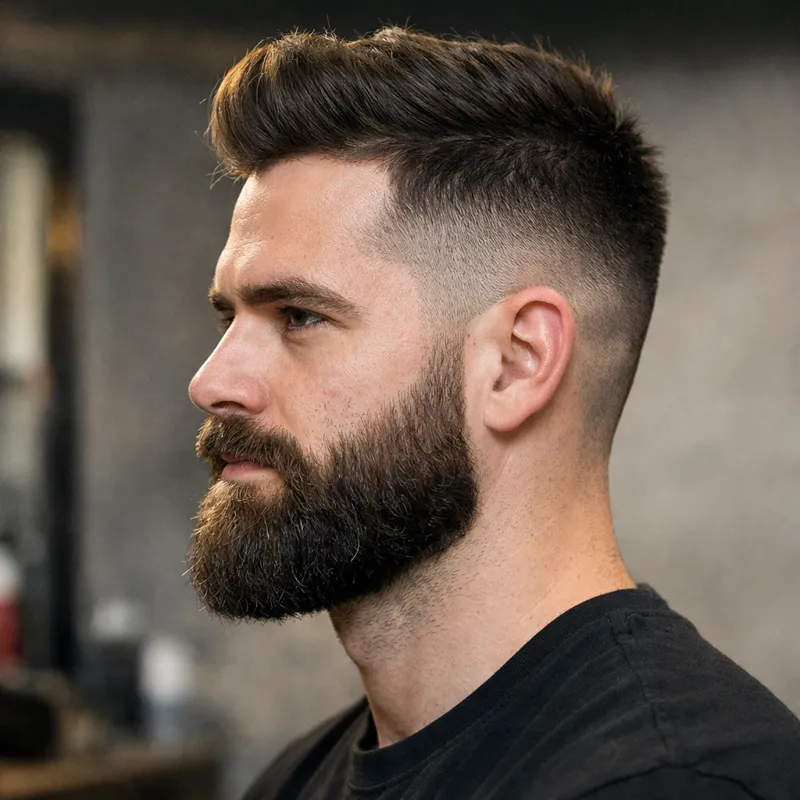
If you wear a beard, the difference between “I just rolled out of bed” and “this is my style” is your beard cut. Shape, lines and length all send a message, and you control that message every time you trim.
In this guide you will learn how to choose the right beard cut for your face, the exact tools you need, and step-by-step methods to get a clean, sharp result at home or in the barbershop.
What Is a Beard Cut and Why It Matters
A beard cut is the combination of shape, length and edges that defines how your facial hair sits on your face. It is more than just “long” or “short” – it is the neckline, the cheek line, the fade into your sideburns and the way your moustache connects.
When your beard cut is intentional, it frames your jaw, balances your features and works with your hairstyle instead of fighting it. A good beard cut can slim your face, soften sharp features or add structure if your jawline is not very defined.
According to master barbers with years behind the chair, the biggest difference between a “good beard” and a “great beard” is how clean the transitions are: from beard to neck, to cheeks, and into your haircut.
How to Choose the Best Beard Cut for Your Face Shape
Before you grab the clippers, you need a plan. Your face shape tells you which beard cut will naturally look balanced and which one will exaggerate what you already have.
1. Identify Your Face Shape in 30 Seconds
Stand in front of a mirror and look at three things: forehead width, cheekbone width and jawline length.
- Round face: cheeks are the widest part; jaw is soft with few angles.
- Square face: forehead, cheeks and jaw are similar width; jaw is strong and angular.
- Oval face: face longer than it is wide, with soft but visible angles.
- Rectangle / oblong: face is clearly longer than wide, with straight sides.
- Triangle / diamond: jaw wider than forehead, or cheekbones very prominent.
2. Beard Cut Recommendations by Face Shape
Round Face: Add Angles and Length
If your face is round, you want your beard cut to make it look slightly longer and more angular.
- Goal: length at the chin, shorter on the sides.
- Best cuts: pointed goatee, short boxed beard with defined angles, Van Dyke, ducktail.
- Avoid: full rounded beards with bulk on the cheeks; they make the face look wider.
Square Face: Soften the Corners
With a square jaw, you already have strong structure. Your beard cut should respect that but avoid making the jaw look too heavy.
- Goal: keep the jaw neat, add a little length to the chin, soften the corners.
- Best cuts: short boxed beard, circle beard, goatee with soft edges, low fade into sideburns.
- Avoid: big square beards with sharp 90-degree corners at the jaw.
Oval Face: Most Beard Cuts Work
Oval faces are very versatile. You can wear most beard cuts as long as they are well maintained.
- Goal: keep proportions balanced; do not over-elongate the face.
- Best cuts: full beard, stubble, corporate beard, faded beard, short to medium length styles.
- Avoid: extremely long beards unless you are going for a very specific style.
Rectangle / Oblong Face: Keep It Tighter at the Bottom
If your face is long, adding too much length at the chin will stretch it visually even more.
- Goal: add width on the cheeks, reduce length at the chin.
- Best cuts: fuller sides with a more squared-off bottom, short beard, heavy stubble.
- Avoid: long pointy beards and extreme goatees.
Triangle / Diamond Face: Balance a Strong Jaw or Cheekbones
When your jaw or cheekbones dominate your face, your beard cut should bring attention back toward the center.
- Goal: soften a wide jaw, or fill in a narrow chin.
- Best cuts: fuller chin for narrow jaws; well-groomed full beard to soften a very wide jaw; moustache and goatee combos.
- Avoid: super short beards that only outline a very wide jaw.
Essential Tools and Products for a Clean Beard Cut
You do not need a full barbershop at home, but a few solid tools will completely change how sharp your beard cut looks.
Core Tools
- Beard trimmer or clipper: adjustable guard lengths give you control over the shape and fade.
- Detail trimmer or precision attachment: for carving cheek and neckline edges.
- Beard scissors: to tidy flyaway hairs and moustache edges.
- Beard comb and brush: to detangle, align hairs and train growth direction.
- Razor (safety, cartridge or shavette): for ultra-clean lines on cheeks and neck.
Products That Upgrade Your Result
- Beard wash: gentle cleanser formulated for facial hair and skin.
- Beard oil: softens hair, reduces itch and makes lines look neater.
- Beard balm or cream: adds light hold and helps control shape.
- Shaving gel or transparent cream: lets you see the lines you are cutting.
- Aftershave lotion or balm: calms irritation after lining up your beard.
Jake Thompson, a master barber and men’s grooming expert, emphasizes that your tools should match your beard density: thicker beards need a powerful trimmer and sharp blades, while softer growth can do well with lighter gear as long as it is maintained well.
Step-by-Step: How to Cut and Shape Your Beard at Home
Follow this sequence to get a clean, professional-looking beard cut without guessing. Take your time the first few sessions; after that, it becomes routine.
Step 1: Let Your Beard Grow to a Working Length
If you are starting from scratch or from a very short trim, give your beard 2–4 weeks to grow. You need enough length to see your natural density and decide on a shape.
Step 2: Wash, Dry and Comb
- Wash your beard with warm water and a beard wash.
- Pat it dry with a towel; avoid aggressive rubbing.
- Comb your beard in the direction of growth (usually downwards on the cheeks, forward on the chin).
Step 3: Set an Overall Length
- Attach a guard to your trimmer that is slightly longer than you think you want.
- Trim the whole beard in the direction of hair growth.
- Step back, look in the mirror, and only then decide if you want to go shorter.
- Repeat with a shorter guard if needed, keeping your original plan by face shape in mind.
Step 4: Define the Neckline
The neckline makes or breaks your beard cut. Too high and your beard looks like a chin strap; too low and it looks sloppy.
- Look straight ahead. Place two fingers above your Adam’s apple. The top finger is a good starting point for the lowest part of your neckline.
- Imagine a gentle curve from that point up to the underside of each ear.
- Using your trimmer without a guard, carefully shave everything below that line.
- For a sharper look, go over the line with a razor and transparent gel.
Step 5: Shape the Cheek Line
Your cheek line controls how “sharp” or “natural” your beard looks.
- Decide if you want a natural cheek line (soft, following natural growth) or a sculpted line (clean, lower and very defined).
- For a natural look, remove only obvious stray hairs above the main beard area.
- For a sculpted look, draw an imaginary line from the top of the sideburn to the corner of the mouth or slightly above it.
- Use your detail trimmer or razor to clean everything above that line.
Step 6: Tidy the Moustache
- Comb the moustache hairs straight down.
- With scissors, carefully trim hairs that fall over the top of your upper lip.
- If you like a very sharp look, use a trimmer without guard to clean the area just under the nose.
- Decide whether you want the moustache to fully connect with the beard or be slightly separated for definition.
Step 7: Fade the Sides (Optional but Powerful)
Fading your beard into your haircut creates a modern, polished transition.
- Choose three guard lengths: one for the lower cheeks, one shorter for the upper cheeks, and one that matches or blends into your haircut near the temples.
- Start with the longest length on the lower cheeks.
- Switch to the middle length and work the upper cheeks, stopping just below the sideburn.
- Use the shortest length at the sideburn to connect with your haircut.
- Always move the clipper in small, upward flicking motions to avoid harsh lines.
Step 8: Final Check and Detailing
- Rinse your face to remove loose hairs and pat dry.
- Comb your beard into place and look at it from the front, sides and slightly from above.
- Use scissors to cut any long, isolated hairs that stand out from the shape.
- Apply a few drops of beard oil and a small amount of balm if you need light hold.
Popular Beard Cuts for Men and How to Get Each Look
Now that you know the basics, here are specific beard cuts you can try, with simple guidance on how to shape them.
1. Light Stubble (The 3–Day Beard)
Light stubble suits almost every man and works in casual and professional settings.
- Length: 0.5–1.5 mm, depending on how quickly you grow hair.
- How to get it: use a trimmer with a fixed stubble guard; run it evenly over the face every 2–3 days.
- Key detail: keep the neckline and cheek lines clean so it looks intentional, not lazy.
2. Heavy Stubble
Heavy stubble gives you a rugged look while still being low maintenance.
- Length: around 2–4 mm.
- How to get it: grow your beard for about a week, then even it out with a 2–4 mm guard.
- Key detail: fade slightly between the beard and the under-chin area for a softer transition.
3. Short Boxed Beard
The short boxed beard is a full beard with controlled length and precise edges. It works especially well for square, round and oval faces.
- Length: usually 5–15 mm.
- How to get it: set the overall length with your trimmer, carve a clean neckline two fingers above the Adam’s apple, and define strong cheek lines.
- Key detail: slightly longer hair at the chin and a neat moustache that connects to the beard.
4. Goatee and Variations
Goatees focus attention on the mouth and chin and are ideal if your cheeks are patchy or if you want to elongate a round face.
- Classic goatee: hair only on the chin, no moustache.
- Circle beard: goatee connected to a moustache around the mouth.
- Van Dyke: pointy goatee with separated moustache.
To create any of these, shave the cheeks completely smooth, then carefully outline the shape around your mouth with a detail trimmer and razor.
5. Full Beard
A full beard highlights your natural growth pattern and can be tailored to almost any face shape if you control the bulk.
- Length: from 1 cm to several centimetres.
- How to get it: let it grow for 4–8 weeks, then define neck and cheek lines, even the length with a guard, and shape the sides based on your face shape.
- Key detail: regular trims on the sides to keep the silhouette clean, with more length on the chin if you want extra structure.
6. Beard Fade
The beard fade blends your beard into your haircut with gradual changes in length. It is modern and works especially well with fades and undercuts.
- Length: varies from skin or zero at the temples up to your full beard length on the jaw.
- How to get it: use multiple guard lengths from shortest near the hairline to longest at the jaw, using flicking motions and checking the blend in natural light.
- Key detail: take your time around the sideburn; that small area controls the whole look.
7. Corporate Beard
The corporate beard is a medium-short, neatly shaped beard that fits professional environments.
- Length: typically 3–7 mm.
- How to get it: trim to an even length, clean the neckline and cheeks daily or every other day, and keep the moustache tidy.
- Key detail: zero stray hairs on the neck and cheeks; the beard edges should look as clean as your shirt collar.
Beard Maintenance: Keep Your Cut Looking Fresh
Once you have a beard cut you like, the goal is to keep it sharp without spending half your week in front of the mirror. Consistent, small actions work better than big overhauls every month.
Daily and Weekly Routine
- Daily: rinse your beard with lukewarm water, apply a small amount of beard oil, and brush or comb into shape.
- Every 2–3 days: check your neckline and cheek lines; touch up any obvious growth outside your defined shape.
- Once a week: wash with beard wash, trim to your chosen length, tidy the moustache and remove split ends with scissors.
How Often to Visit the Barber
If you like a more complex beard fade or very precise lines, schedule a barber visit every 2–4 weeks, depending on how fast your hair grows. At the appointment, ask your barber to explain the lengths and lines they use so you can maintain the shape in between visits.
Common Mistakes to Avoid
- Cutting the neckline too high: this makes the beard look like it is floating on your face.
- Ignoring the moustache: even a great beard cut looks messy if the moustache covers your lips.
- Using body soap on your beard: it dries the skin and can cause itch and dandruff.
- Chasing perfect symmetry: your face is not perfectly symmetrical; aim for “balanced,” not “identical.”
FAQs About Beard Cuts for Men
How often should I cut my beard to keep the shape?
For most men, trimming every 7–10 days is enough to maintain a clear beard cut. If you wear very short stubble or a sharp corporate beard, you may prefer a quick touch-up every 3–4 days on the neckline and cheeks.
What is the best beard cut for patchy growth?
If your cheeks are patchy, focus on styles that do not rely on full coverage there. Goatees, circle beards and heavy stubble often work well. Keep the patchy areas shorter and let stronger areas like the chin carry more weight.
Where should my beard neckline be?
A practical guide is to place two fingers above your Adam’s apple and draw a smooth curve from that point to the underside of each ear. Shave everything below. This avoids cutting too high while still looking clean from the front and sides.
Can I combine a fade haircut with a beard fade?
Yes. A fade haircut with a beard fade creates a very cohesive, modern look. Use shorter guard lengths around the temples and sideburns, then gradually increase toward the jaw. Take your time blending to avoid visible steps between lengths.
Do I need beard oil if my beard is short?
Beard oil is still helpful on short beards because it conditions the hair and hydrates the skin under it. Use just a drop or two, rub it between your hands and work it into the beard and skin for softness and less itch.
How do I ask my barber for a specific beard cut?
Show your barber clear photos from the front and side, and explain what you like about each picture: length on the chin, cheek line height, and how sharp the neckline is. Mention your job and dress code so they can adjust the style to your daily life.