
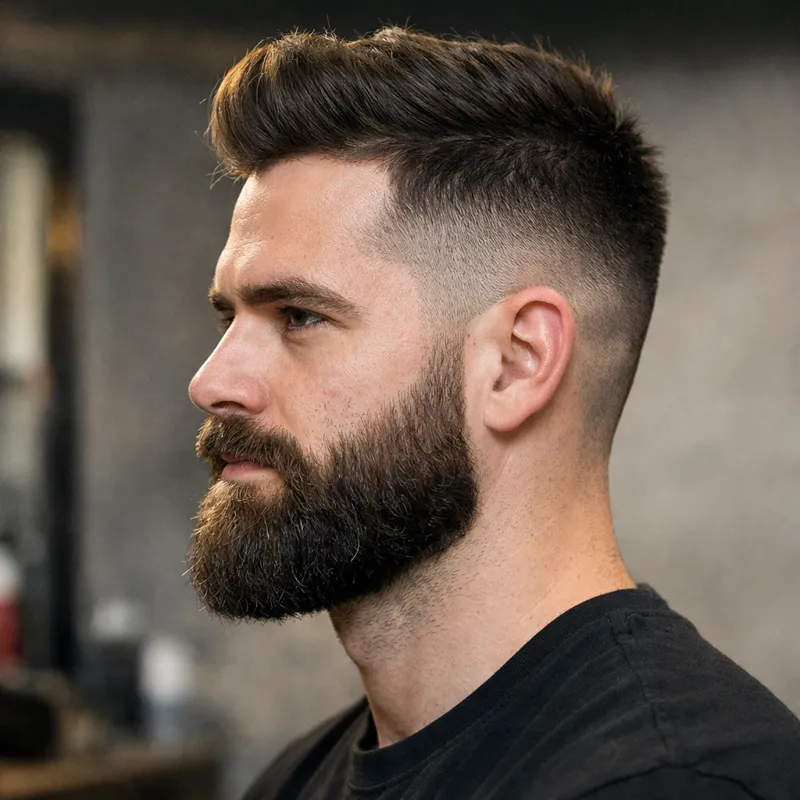
If you like your beard to look sharp rather than scruffy, a beard fade is one of the cleanest, most modern options you can choose. It blends your beard smoothly into your haircut, gives your jaw more definition and works with almost every face shape.
In this guide you’ll see exactly what a beard fade is, who it suits, which tools you need and how to get the look step by step – whether you go to a barber or want to try it at home.
What Is a Beard Fade?
A beard fade is a gradual transition from shorter facial hair to longer facial hair, usually starting high on the cheek or sideburn area and getting fuller as it moves down toward the jaw and chin. Instead of a hard line where your haircut ends and your beard begins, everything is blended.
Think of it as the facial-hair version of a fade haircut. The hair never jumps suddenly from very short to very long. It steps up in small guard lengths so the result looks clean and intentional.
Main elements of a beard fade
- Short to long transition: The hair near your temples and upper cheeks is the shortest; the hair on your jaw and chin is the longest.
- Blended sideburns: Sideburns seamlessly connect your haircut to your beard instead of stopping in a straight block.
- Defined cheek and neck lines: The edges are outlined, then softened inside the line so they look crisp but not drawn-on.
- Custom length on chin and moustache: You choose whether you want a short corporate beard, a medium full beard or a stronger long chin.
Who Does a Beard Fade Suit?
The beard fade is flexible. With small tweaks you can make it work for most hair types and face shapes. Here’s how to think about it.
By face shape
- Round face: Keep the fade higher on the cheeks and shorter on the sides, then leave more length on the chin. This visually “stretches” your face and makes it look slimmer.
- Square face: Go for a softer fade with rounded corners on the jaw instead of sharp angles. Slightly more length on the sides of the jaw can balance a strong, wide jawline.
- Oval face: You can wear almost any beard fade. A mid fade on the cheeks with medium chin length usually looks very natural.
- Long face: Avoid too much extra length on the chin. Keep the chin shorter and allow a little more fullness on the sides so your face doesn’t look even longer.
By beard density
- Thick, dense beard: Ideal for a sharp beard fade. Your barber can remove bulk on the sides and keep the shape clean without gaps.
- Patchy cheeks: A high or mid fade can hide weaker areas by intentionally shortening them, while keeping more fullness along the jaw and chin where your growth is stronger.
- Blonde or light beard: Ask for slightly more contrast in guard lengths so the fade is still visible even though your hair color is light.
By workplace and lifestyle
- Corporate / office: A low to mid beard fade with short overall length looks professional and low maintenance.
- Creative or casual: You can play with a higher fade, sharper cheek lines and more length on the chin for a stronger statement.
- Active lifestyle: Keep the beard shorter overall, but use the fade to keep everything neat around the ears and neckline so sweat and helmets don’t cause irritation.
Types of Beard Fades
Not every beard fade looks the same. Small changes in where the fade starts and how strong the contrast is can completely change your look. These are the most common versions.
1. Low Beard Fade
The fade starts just above the jawline and stays subtle. This is ideal if you want a clean beard without showing too much skin on the cheeks.
- Works well with: business cuts, side parts, tapered haircuts.
- Good for: conservative workplaces, first time trying a fade.
2. Mid Beard Fade
The fade starts around the middle of the cheek. It shows more contrast and usually lines up with a mid fade in the haircut.
- Works well with: textured crops, quiffs, modern fades.
- Good for: most face shapes, especially oval and round.
3. High Beard Fade
The fade starts close to the temple, right where a high skin fade or high taper haircut would begin. The cheek area is very short or even down to skin, while the jaw and chin keep length.
- Works well with: high fade haircuts, buzz cuts, strong quiffs.
- Good for: guys who like bold, modern barbered looks.
4. Tapered Beard Fade (Sideburn Fade)
Here the focus is on blending just the sideburns into the haircut, with a gentle taper that melts into a fuller beard on the jaw.
- Works well with: tapered haircuts, pompadours, slick backs.
- Good for: anyone who wants a neat transition but prefers a fuller beard overall.
5. Short Stubble Beard Fade
This look keeps the beard in stubble territory, but still uses different guard lengths to fade from the hair into the beard and along the cheeks.
- Works well with: crew cuts, textured crops, professional styles.
- Good for: men whose beards grow very fast and want minimum maintenance.
Tools and Products You Need for a Beard Fade
Whether you go to a professional or do it at home, the right tools make all the difference to your beard fade. Here is a simple checklist.
Essential tools
- Quality clippers with guard attachments (at least #0.5, #1, #1.5, #2, #3).
- Detail trimmer or edging trimmer for clean lines around the cheeks and neck.
- Beard scissors for balancing stray hairs and mustache details.
- Beard comb and/or brush to keep the hair lifted and even while you trim.
- Razor or single blade (optional) to sharpen cheek and neck lines.
Grooming products
- Beard wash or gentle shampoo: keeps the beard clean without drying it out.
- Beard oil: softens the hair, reduces itch and adds a light, healthy shine.
- Beard balm: adds light hold and helps control flyaways on the sides.
- Aftershave or soothing lotion: calms the skin after you clean up the edges.
How to Ask Your Barber for a Beard Fade
Most barbers are happy to shape your beard, but it helps to speak their language so you get exactly what you want. Use these points during your next appointment.
- Show your current growth. Let your beard grow for at least 7–10 days before your appointment so your barber has something to work with.
- Bring a reference photo. A picture is still the fastest way to communicate the type of fade you have in mind: low, mid, high or just a light taper.
- Say how short you’re comfortable going. Mention if you’re okay with skin showing on the cheeks or if you prefer everything to stay in stubble range.
- Explain your routine. If you don’t want to trim at home, ask your barber to keep a shape that grows out nicely for four weeks.
- Discuss your neckline. Decide whether you want a higher, sharper neck line or a more natural one that sits just above your Adam’s apple.
During the service, don’t be afraid to ask for a mirror check when your barber finishes one side. That way small adjustments can be made before everything is fully outlined.
How to Do a Beard Fade at Home: Step-by-Step
If you’re comfortable with clippers, you can maintain a simple beard fade between barber visits or even create the full look yourself. Follow these steps slowly and always work with the grain of your hair.
1. Prep your beard and skin
- Wash your face and beard with warm water and beard wash.
- Pat dry with a towel, leaving the hair slightly damp, not dripping.
- Comb or brush your beard down into its natural growth direction so you can see the real length and density.
2. Decide your longest length
Choose the guard length you want to keep on the fullest parts of your beard, usually the jaw and chin. For a short beard fade this might be a #3 or #4 guard; for heavier beards, you might trim freehand with scissors instead of a guard.
- Attach the longest guard to your clippers.
- Trim the chin and jaw area evenly, moving with the grain.
- Comb and re-trim to catch any uneven patches.
3. Create your cheek and neck lines
- Use your trimmer (no guard) to outline your cheek line. Follow your natural growth but clean up strays above the line.
- For the neckline, imagine a curved line from just behind one ear, passing about one or two fingers above your Adam’s apple, to the other ear.
- Clean below that line with a trimmer or razor so the beard looks intentional, not overgrown.
4. Start the fade on the sides
This is where the beard fade really takes shape.
- Switch to a guard one step shorter than your longest length (for example, from #3 down to #2).
- Place the clippers about halfway up your cheek and move downward in short strokes toward the jaw, blending into the longer length.
- Use a light flicking motion at the end of each stroke so you don’t create harsh lines.
5. Tighten the fade toward the top
- Change to the next shorter guard (for example, from #2 to #1 or #1.5).
- Work in an even smaller zone higher on the cheek, starting around the bottom of the sideburn.
- Again, move the clippers downward and flick out before you reach the middle of the cheek so the shorter hair blends smoothly into the area you just cut with the longer guard.
6. Blend the sideburn into your haircut
- If your hair is faded, match the guard lengths of your haircut as you move up the sideburn so there’s no visible step where hair ends and beard starts.
- Use your shortest guard or even no guard right at the edge of the fade if you like a very clean, high beard fade.
- Repeat the same pattern on the other side, checking for symmetry in the mirror.
7. Detail the moustache and chin
- Comb the moustache downward over your lip.
- Use scissors or a trimmer to cut just along the lip line so hair doesn’t hang over.
- If you want extra emphasis on the chin, leave it slightly longer than the sides, then carefully knock off only the very ends to keep it tidy.
8. Check both sides and refine
- Turn your head side to side in the mirror to compare both fades.
- If one side looks darker or bulkier, lightly go over that area again with the previous guard to even it out.
- Rinse your face with cool water to remove loose hairs and calm the skin.
9. Finish with product
- Apply a few drops of beard oil, working it into the skin underneath and then through the beard.
- Use a small amount of beard balm on the sides to control puffiness and hold the shape of your fade.
- Brush the beard into place and you’re done.
Maintenance Tips to Keep Your Beard Fade Sharp
A beard fade looks best when the transition stays clean and the lines are fresh. The good news is that maintenance doesn’t have to be complicated.
- Refresh the fade every 5–7 days: Use your clippers on the cheeks and sideburns only, keeping the original guard pattern.
- Trim the neckline weekly: A messy neckline is the fastest way for a beard fade to look untidy.
- Wash 2–3 times per week: Over-washing can dry out your beard; in between, just rinse with warm water.
- Use beard oil daily: This keeps the hair soft and makes the fade look more polished.
- Visit your barber every 3–4 weeks: A professional reshaping brings everything back to balance, especially if your beard grows unevenly.
Common Beard Fade Mistakes (and How to Fix Them)
Even experienced guys run into problems when they start fading their own beards. Here are the most common mistakes and how to avoid them.
1. Cutting the fade too high on the cheek
If you push the fade too high, you lose density and the beard can look thin or accidental.
Fix: Next time, start your shortest guard slightly lower and keep more length on the upper cheek. You can also let the beard grow for a week to fill back in before reshaping.
2. Visible lines between guard lengths
Harsh steps usually mean you moved the clippers in straight, heavy passes or skipped a guard size.
Fix: Go back with a middle guard (for example #1.5 if you used #1 and #2) and use a light flicking motion across the line to soften it.
3. Uneven sides
One side often grows slightly differently from the other, so using exactly the same stroke length can create unevenness.
Fix: Use the mirror more actively. Compare from the front, then from each side. Take off less hair and adjust gradually rather than trying to match in one go.
4. Neckline too high
A neckline that sits right under your jaw can make your beard look like a chin strap.
Fix: Lower the line to just above your Adam’s apple, following a gentle curve. Give it a week to grow down if you’ve already taken it too high.
5. Dry, wiry beard texture
A fade won’t look sharp if the hair itself is dry and fluffy.
Fix: Add beard oil after every wash and consider a light balm on the sides. Comb twice a day to train the hair to lie in the direction of the fade.
Beard Fade Combinations with Popular Haircuts
The beard fade really comes to life when it matches the style and intensity of your haircut. Here are a few reliable combinations.
- High skin fade + high beard fade: Strong contrast, perfect if you like a sharp, modern look.
- Low taper + low beard fade: More subtle and professional, great for office environments.
- Textured crop + mid beard fade: The texture on top balances the clean, controlled cheek area.
- Buzz cut + short stubble fade: Simple, extremely low maintenance but still very intentional.
- Side part + tapered beard: Classic, timeless combination that suits both casual and formal outfits.
When in doubt, mirror the fade level in your hair and beard so the whole look feels connected rather than like two separate styles.
Final Thoughts: Make the Beard Fade Your Own
A beard fade is more than a trend. It’s a way to control how your facial hair frames your face, connects to your haircut and fits your lifestyle. Once you understand the basic idea – shorter on top, longer on the jaw, smoothly blended – you can adjust the details to suit you.
Start with a professional cut if you’re unsure, pay attention to which guard lengths your barber uses and then maintain the shape at home with small, careful trims. Over time you’ll learn how your beard grows, which fade level you prefer and how often you need to refresh it to keep that clean, sharp finish.
Frequently Asked Questions About Beard Fades
How often should I get my beard fade redone?
Most men refresh their beard fade every 1–2 weeks. If your hair grows quickly or you like a very sharp look, aim for weekly touch-ups. Between appointments you can clean the neckline and cheek lines yourself to keep it neat.
Can I do a beard fade if my beard is patchy?
Yes. In fact, a beard fade can help a patchy beard look more intentional. By keeping the weaker areas shorter and the jaw and chin slightly fuller, the contrast distracts from thin spots and gives a cleaner overall shape.
Do I need professional clippers to fade my beard at home?
You don’t need a barbershop-level machine, but you do need reliable clippers with sharp blades and several guard sizes. Cheap, weak clippers tend to tug, leave uneven patches and make it harder to blend guards smoothly.
What’s the difference between a beard fade and a tapered beard?
A beard fade usually has a stronger, more visible transition from very short to longer hair, especially on the cheeks. A tapered beard is softer and focuses mainly on blending the sideburns into the haircut while keeping the rest of the beard fuller.
Which products should I use after getting a beard fade?
Use a gentle beard wash a few times per week, beard oil daily to keep the hair soft and the skin hydrated, and a light beard balm on the sides if your hair tends to puff out. A soothing aftershave or lotion helps with any irritation after edging.