
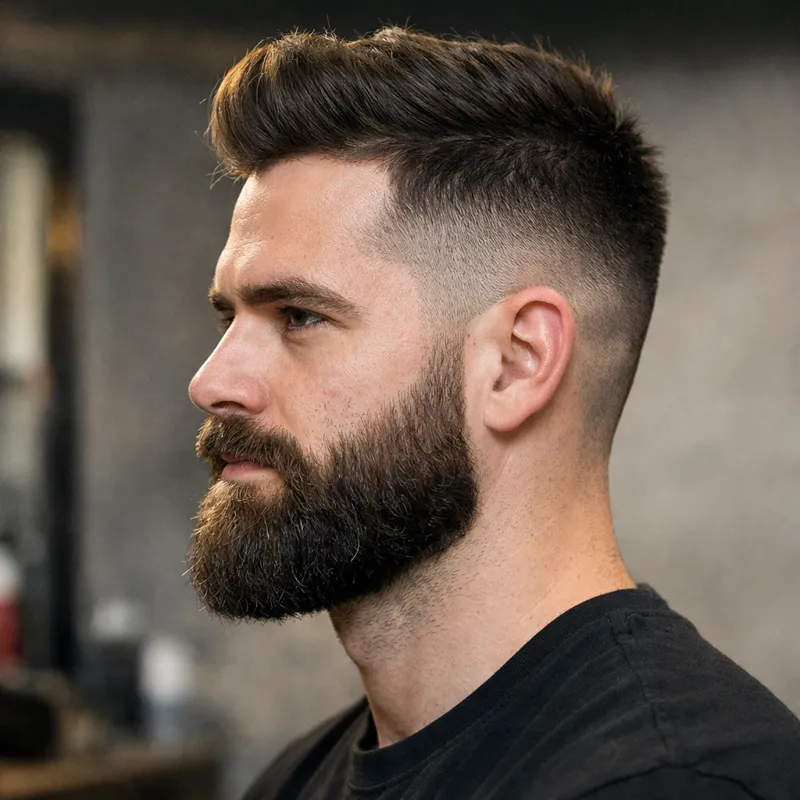
If you like the idea of a beard but don’t want a wild, overgrown look, the small beard style is your sweet spot. Short, clean and sharp, it frames your face, adds definition to your jaw, and still looks professional in any setting.
Think of it as the modern middle ground between clean‑shaven and full lumberjack. You keep the beard close to the skin, lines are crisp, and the overall effect is intentional, not accidental.
What Is a “Beard Small Style”?
When barbers talk about a small beard style, they usually mean a beard that stays relatively short in length and compact in shape. It’s groomed tight to the face, often paired with a neat haircut, and it never looks puffy or bulky.
In practice, that means most of the beard stays between 1 mm and about 12 mm (0.04–0.5 inches). Anything longer starts to move into medium or long beard territory.
A small beard style can still be bold, but it always looks deliberate. The cheeks, neckline and mustache are shaped to match your face and your haircut, so the whole look feels cohesive.
Why a Small Beard Style Works So Well
A good short beard can do more for your face than most people realize. Here’s why this look is so popular:
- It sharpens your jawline: Even a few millimeters of stubble, trimmed properly, can make your jaw and chin look more structured.
- It fits almost any workplace: Kept short and clean, a beard small style looks polished, not messy, so it passes in most professional environments.
- It’s lower maintenance than a long beard: You still need to trim and care for it, but you won’t be detangling or blow‑drying anything.
- It can hide minor imperfections: A small beard helps soften acne scars, minor asymmetries or a weaker chin without completely hiding your face.
- It pairs easily with modern haircuts: Fades, tapers, buzz cuts or slick backs all work beautifully with a precise, compact beard.
According to master barbers with years behind the chair, the biggest difference between a great short beard and a forgettable one is the attention you give to the lines: cheek, neck and mustache. That’s where your beard stops looking “accidental” and starts looking styled.
Best Small Beard Styles to Try
“Small beard” covers a family of styles rather than one rigid look. Below are the most versatile options, plus who they suit best.
1. Designer Stubble (The 3‑Day Beard)
This is the classic short beard style: long enough that you clearly have facial hair, short enough that it never looks messy if you maintain it.
Who it suits:
- Men with baby‑face features who want a bit more maturity.
- Round faces that need a touch of shadow to add structure.
- Anyone who wants the easiest possible small beard style to start with.
2. Short Boxed Beard
The short boxed beard is compact, with clearly defined lines on the cheeks and a tight, controlled neckline. It usually sits around 6–12 mm in length.
Who it suits:
- Men with office jobs who still want a strong beard presence.
- Oval and square faces, where the jawline is already fairly balanced.
- Guys who like a “finished” look rather than a casual stubble.
3. Goatee and Small Chin Beard
Here, most of the beard is focused around your chin and mustache, with minimal or no hair on the cheeks. Length usually stays in the short range for a crisp, compact feel.
Who it suits:
- Men with patchy cheeks but strong growth on the chin and mustache.
- Round or oval faces that need extra length visually.
- Anyone who wants their chin to look more prominent.
4. Short Beard With Faded Sideburns
This style connects your haircut and beard through a fade: the hair gradually shortens from the head into the beard, instead of a hard line.
Who it suits:
- Men who already wear a fade, taper or undercut.
- Guys with fuller sideburn growth who want a smooth transition.
- Anyone who likes a modern barbershop look without going over the top.
5. Short Beard With Defined Mustache
Here the beard sits short across the face, but the mustache is slightly more defined, sometimes with a subtle outline at the top lip.
Who it suits:
- Men who want facial hair to be part of their signature look.
- Guys with naturally thick mustache growth.
- Anyone who wants a touch of classic style without committing to a big handlebar.
Tools and Products You Need for a Small Beard Style
Before you start shaping your beard, get your toolkit right. With the correct tools, maintaining a small beard becomes quick and consistent.
Essential tools
- Beard trimmer with guards: Choose one with multiple length settings down to at least 1 mm, with reliable power.
- Detail trimmer or precision attachment: For working around the mustache, lips and edges.
- Razor or shavette: To clean the neck and cheeks below or above your beard lines.
- Beard scissors: Handy for the mustache and any stray hairs that stick out.
- Beard comb or small brush: To align the hair before you trim and to check for uneven spots.
Care and styling products
- Gentle beard wash: Cleans the hair without drying the skin underneath.
- Beard oil: Softens the hair, reduces itch and gives a healthy, subtle sheen.
- Light beard balm or cream: Adds a bit of control and shape without hard hold.
- Aftershave or soothing lotion: Calms any irritation around freshly shaved lines.
A small beard style doesn’t require a bathroom full of products. Focus on a good trimmer, a gentle cleanser and one hydrating product like beard oil. That combination covers 90% of your daily needs.
How to Shape a Small Beard Style: Step‑by‑Step
Here’s a practical routine you can follow at home to get a sharp, short beard. Adjust the length settings to match the exact style you’re going for.
Step 1: Let It Grow (Just a Little)
If you’re starting from clean‑shaven, you need some growth before you can shape anything.
- Let your beard grow untouched for 5–10 days, depending on how fast your hair grows.
- During this time, only clean up obvious stray hairs on your neck if you have a meeting or event, but avoid shaping the main lines.
- Use a gentle wash and a bit of beard oil to keep the skin from getting itchy.
Step 2: Set Your Base Length
Now you’ll define the overall length that turns random growth into a real style.
- Attach a guard to your trimmer. For designer stubble, start around 2–3 mm. For a short boxed beard, start around 6 mm.
- Trim with the grain first (in the direction the hair grows) to reduce bulk gradually.
- Then go against the grain carefully for an even finish.
- Work in sections: cheeks, jawline, chin, then mustache.
Check in the mirror from both sides and slightly below the chin. Small beards show uneven patches much more than long beards, so take your time.
Step 3: Define the Neckline
A clean neckline is one of the biggest visual upgrades for a small beard style. It prevents everything from blending into your neck.
- Look straight ahead in the mirror and locate your Adam’s apple.
- Place two fingers above it. The top of your fingers is roughly where your neckline should sit.
- Draw an imaginary gentle curve from that point up toward the back of each ear, following your natural jaw shape.
- Use your trimmer (without guard) to outline this curve.
- Shave everything below the line with a razor or close trimmer setting.
For a more relaxed, natural look, you can keep the neckline slightly lower. For a very sharp, compact beard, keep it higher and closer to the jaw.
Step 4: Clean the Cheek Line
Next, tidy the area between your beard and your eyes. For most small beard styles, you want a clear, slightly curved cheek line.
- Smile gently to see where your cheeks lift.
- Visualize a line from the top of your sideburn down to the corner of your mouth or just above it.
- Trim or shave any hairs that grow clearly above this imaginary line.
- If your natural growth is patchy high on the cheeks, set the line lower and follow the fullest area of hair.
Don’t worry about making both sides 100% identical on your first try. Aim for symmetry, then refine it slightly each time you trim.
Step 5: Detail the Mustache
The mustache is a small area, but it changes the way your whole face looks. For a clean, short beard style:
- Comb the mustache down over your top lip.
- Use scissors or a precision trimmer to cut any hairs that hang over your lip line.
- If you like a very defined look, trim a subtle outline along the top of the mustache where it meets the skin.
- Match the length to your beard or keep it half a millimeter longer for a slightly stronger presence.
Step 6: Check for Balance and Clean Up
Once the key lines are set, do a quick quality check.
- Comb through the beard in all directions.
- Check the jawline and under the chin for longer patches the trimmer might have missed.
- Use the trimmer or scissors to catch any stray hairs that stick out from the overall shape.
- Rinse your face with cool water and apply a light, alcohol‑free aftershave or moisturizer.
Step back from the mirror and look at your entire head: hair, beard and neck. A small beard style works best when it feels like part of a bigger picture, not a separate element.
Matching Your Small Beard Style to Your Face Shape
The same beard can look very different on two people. Use your face shape as a guide to fine‑tune your small beard.
Round Face
Goal: add length and definition.
- Keep the sides a bit shorter and allow slightly more length on the chin.
- A short boxed beard with a subtle point at the chin works well.
- A goatee or chin‑focused beard is also a strong option.
Square Face
Goal: soften angles without losing strength.
- A uniform short length (like 4–6 mm) across cheeks, jaw and chin often looks best.
- Round off the bottom of the beard a little so it doesn’t exaggerate the square jaw.
- A slightly fuller mustache can balance a strong chin.
Oval Face
Goal: keep balance and flexibility.
- You can wear almost any small beard style; focus on clean lines.
- Try a neat short boxed beard for everyday, then adjust length on the chin if you want more edge.
- If your face is very long, avoid adding too much extra length at the bottom.
Heart or Diamond Face
Goal: add some width at the jaw.
- Keep good coverage along the jawline and under the chin.
- A short beard that’s slightly fuller at the corners of the jaw can balance a narrower chin.
- A soft, not overly thick mustache usually works best.
Daily and Weekly Maintenance for a Sharp Small Beard
Once your beard is shaped, maintenance is what keeps it in the “polished” category.
Daily routine (3–5 minutes)
- Rinse your beard with lukewarm water in the shower; use beard wash 2–3 times a week.
- Pat dry with a towel rather than rubbing hard.
- Apply 2–4 drops of beard oil, depending on length and thickness.
- Comb or brush the beard into place, following your natural growth pattern.
Every 2–3 days
- Lightly run the trimmer over the beard using the same guard length to keep everything even.
- Check and tidy the neckline and cheek lines if they start to blur.
- Trim the mustache off the lip for a clean mouth area.
Once a week
- Do a more thorough trim, section by section.
- Re‑draw and refine your neckline and cheek lines.
- Examine your skin for any irritation or ingrown hairs and treat early.
Consistency matters more than perfection. Small, regular touch‑ups keep your beard in shape far better than waiting too long and trying to fix everything at once.
Beard Small Style and Haircut Combinations
Your haircut can make or break your beard style. Some combinations feel naturally balanced and modern.
Short Hair and Small Beard
A short, tidy haircut with a small beard is one of the most flexible looks you can wear. It works for everyday, dates and the office without major changes.
Fade or Taper With a Small Beard
A skin fade or taper adds structure above the ears, while the short beard adds it along the jawline. Ask your barber to blend the sideburns into the beard so the transition looks smooth.
Buzz Cut With Small Beard
A buzz cut and neatly trimmed small beard create a minimal, masculine look that’s very easy to maintain. Keep the beard lines extra clean so the style looks intentional, not like you just skipped shaving.
Longer Top, Short Sides and Small Beard
If you prefer more length on top—like a quiff, slick back or textured crop—pair it with a compact beard that doesn’t compete. Keep the beard shorter than the visual volume of your hair so your face doesn’t feel crowded.
Product Tips for a Healthy Small Beard
Because the beard hair is short, skin health matters as much as the hair itself. A few smart product choices go a long way.
- Choose a gentle cleanser: Avoid harsh face washes that strip oils completely. Look for formulas labeled as gentle or designed for beards.
- Use beard oil sparingly: A small beard only needs a couple of drops. Too much oil will make it look greasy instead of groomed.
- Go light on styling: For a small beard style, a light balm or cream offers enough control. Heavy waxes are overkill and can clump.
- Protect against irritation: If your skin gets red around the neckline, use an alcohol‑free aftershave and avoid going over the same area repeatedly with the trimmer.
Common Mistakes With Small Beard Styles (and How to Fix Them)
Even simple beard styles can go wrong. Here are issues barbers see all the time, plus easy fixes.
- Neckline too high: If you cut the neckline right under your jaw, the beard can look like it’s glued to your face. Next time, drop the line slightly lower and follow a gentle curve.
- Cheek line too low: Dropping the cheek line too far down can make the beard look smaller and thinner than it really is. Raise the line to follow your natural fullness.
- Uneven length patches: Often caused by trimming against the grain in some areas and with the grain in others. Use the same motion across the whole beard and double‑check under the chin.
- Over‑trimming the mustache: Cutting it too thin can throw off the balance of your face. Keep it strong enough to stand next to the beard.
- Ignoring the skin: Dry, flaky skin ruins even the neatest beard. Hydrate daily and don’t skip washing and oil just because the beard is small.
FAQ: Small Beard Style and How to Get the Look
How long should I grow my beard before shaping a small beard style?
Most men need 5–10 days of growth before shaping a small beard style. That gives you enough length to see your natural density, decide on the final look and trim everything to an even base length.
What length is best for a small beard style?
For most faces, a small beard style sits between 2 mm and 10 mm. Around 2–3 mm gives you designer stubble, while 6–10 mm creates a short boxed beard that feels fuller but still compact and easy to maintain.
How often should I trim a small beard?
Plan on a light trim every 2–3 days to maintain your chosen length and a more detailed shape‑up once a week. Regular small touch‑ups keep the beard looking sharp without needing big corrections.
How do I find the right neckline for my short beard?
Look for your Adam’s apple, place two fingers above it and use the top of your fingers as a guide. From that point, draw a soft curve toward the back of each ear, then shave everything below the line.
Do I still need beard oil for a small beard style?
Yes. Even a short beard can dry out the skin underneath, causing itch or flakes. Use 2–4 drops of beard oil once a day to keep both the hair and the skin hydrated and comfortable.
Can I get a small beard style if my beard is patchy?
A small beard style can actually work well for patchy growth if you choose the right shape. Goatees, chin beards and short beards with slightly lower cheek lines all help you focus on the strongest areas of hair.